8years old
Collagen 100 of 100
58,400 smiles
One man, two ages.
In a study of 29 cars, side windows blocked just 71% of UVA on average.30
Sculpted for this page, not a photo of him. See the real case.
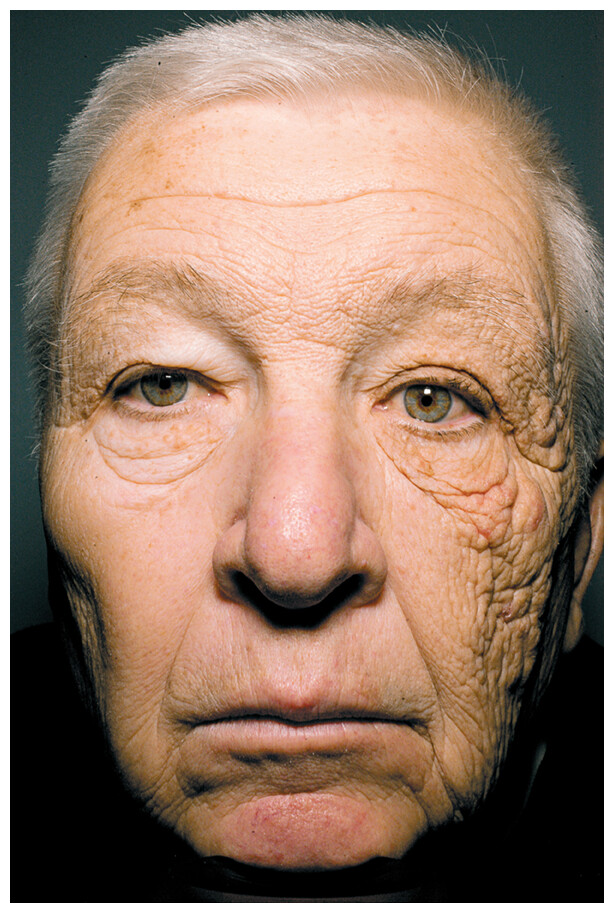
This is him.
Photo: Gordon JR, Brieva JC, 2012, New England Journal of Medicine. © 2012 Massachusetts Medical Society.28One day, the line stays.
Follow a wrinkle
The story of one line, from age 8 to 80. By Eva AI.
Try to wrinkle this skin.
Hold the button, then let go. It snaps flat. At 80, the same fold stays. So what changes?
Look under the line.
This is the skin beside your eye, on a microscope slide. The pink and violet are lab dyes, not skin color. The surface renews itself every four to six weeks12, so the answer isn’t up there. It’s deeper.
Collagen is the rope.
Those wavy pink bundles are about three-quarters of your skin’s dry weight3. Like rope, they’re strong and barely stretch.
Elastin is the spring.
The fine violet threads are just 2 to 4% of the dermis4, and they’re why the fold vanished. Hold the button: the coils pull straight. Let go: they snap back.
Doctors really test this. Pull the lower lid gently from the eye and it should spring back at once5.
Collagen holds. Elastin returns.
That’s the whole system. A wrinkle is what’s left when they wear out. The rest of this story is about what wears them out.
Start the clock at 20.
Call your collagen 100. A classic study of 148 people found it falls about 1% a year through adult life67. You won’t see it for years.
Every smile pulls the same spot.
The muscle around your eye is a ring, attached to the skin around the socket8. That skin is under a millimeter thick9. Wrinkles form at right angles to the pull10, which is why crow’s feet fan outward.
Say you smile 20 times a day.
Nobody has counted yours, but the arithmetic is the point. By 35, that’s about 255,500 folds in the same few millimeters.
For now, it still comes back.
Doctors call this a dynamic line: it arrives with the expression and leaves with it11. Try it. A little slower than at eight.
Smoke shows up. Sugar might.
In 79 pairs of identical twins, a five-year difference in smoking showed in the face20. Sugars slowly bond to collagen, shown here in amber, and skin collagen lasts for years, so they build up2223. But no trial has shown that eating less sugar reduces wrinkles.
Menopause matters. Check the number.
You may have heard women lose 30% of their collagen in five years. That figure appears in reviews24, and we couldn’t find a primary study behind it. Biopsy studies measured about 1 to 2% a year25. Real, but not a cliff.
The frame shrinks under the fabric.
Fat sits in separate compartments that change at different rates, and parts of the facial skeleton recede2627. Skin that fit at 30 now has slack in it.
This is what time alone does.
62 years. Thinner, looser, less collagen. But look how orderly it still is. We left something out.
Now add the sun.
Every day outside, for 62 years. UVB burns, and the surface absorbs almost all of it. UVA is 90 to 95% of the UV that reaches you, and it goes on into the dermis13. Up to 80% of UV gets through cloud, and UVA can pass through ordinary window glass14.
Sunlight cuts collagen.
Within hours, even at doses too low to redden you, skin starts making enzymes that break collagen down15. In one experiment, UV-exposed skin broke down 58% more16. The theory: repair is imperfect, so each round leaves a flaw. Decades of them add up to a scar too fine to see.
Sunlight knots elastin.
Sun-damaged elastin piles up as tangled, blue-grey clumps. It’s called solar elastosis, and it appears in sun-aged skin, not in skin that has simply got older1718.
Melanin is a head start.
Those brown specks absorb UV before it goes deeper. Darker skin tends to show wrinkles later, often by a decade or more, though it’s more prone to uneven pigmentation19. It isn’t immunity.
One man, two ages.
A 69-year-old had driven a delivery truck for more than 25 years. The left side of his face, beside the window, showed far more sun damage than the right2829. In a study of 29 cars, side windows blocked just 71% of UVA on average30.
How much of aging is sun?
A L’Oréal-led study of 298 French women scored it at about 80% of visible facial aging signs31. That’s one group, not a law of nature. In 186 pairs of identical twins, the one with more sun or smoking tended to look older21.
Now do it all at once.
Same line. Same smile. Hold the button and don’t let go.
That’s a wrinkle.
The muscle has let go and the fold is still there. Doctors call it a static line1112. Nothing happened on any particular day. It’s every smile you ever had, and the skin finally keeping one.
Now go back to 35.
Some of that was time, and nobody gets out of time. Much of it wasn’t. The rest of this line hasn’t been drawn yet.
Everything sold for wrinkles does one of five things.
If a product can’t tell you which one, that tells you something.
Shield the collagen.
Strong evidence: a large randomized trial
903 Australian adults under 55 were assigned daily sunscreen, or to use it when they chose. Over four and a half years the daily group showed no detectable increase in skin aging, measured from skin texture, and aged about 24% less32.
The trial used SPF 15 or higher33. Dermatologists now advise broad-spectrum SPF 30 or higher, a shot glass for exposed skin, every two hours outdoors34.
Rebuild the collagen, with a cream.
Strong evidence: randomized trials, for tretinoin
Prescription tretinoin has the best evidence of any cream for sun-aged skin. In one trial, collagen formation rose 80% over 10 to 12 months and fell 14% on placebo3536. Retinol, over the counter, is milder, with smaller studies3738. Expect months, and some irritation. Don’t use retinoids during pregnancy.
Rebuild the collagen, with a laser.
Medical procedure, with recovery time
A fractional laser makes tiny columns of controlled injury and leaves healthy skin between them. Healing lays down new collagen for at least three months4546.
Stop the fold.
Medical procedure, lasts about 3 to 4 months
Botulinum toxin blocks the signal from nerve to muscle41. Hold the button: the skin hardly moves. It works on lines made by movement, not deep lines already there at rest11, and it fades, sometimes after longer than 4 months42.
Fill the fold.
Medical procedure, typically lasts 4 to 12 months
A hyaluronic acid gel placed under a fold lifts it from below43. Some last up to two years44. It treats the shape of the line, not the cause. Who injects it matters.
Plump the surface.
Works, but only on the surface
Moisturizer helps the outer skin hold water, which softens the look of fine lines. It rebuilds nothing39. Hyaluronic acid does help skin hold water, but the famous claim that it binds 1,000 times its weight has no direct experimental support40.
And the rest?
Weak, mixed or no good evidence
Collagen supplements look good in pooled trials47, until a 2025 analysis set aside low-quality and company-funded studies and the benefit disappeared48. Extra water may slightly hydrate the surface, with no good evidence it changes wrinkles49. Face yoga rests on one uncontrolled pilot of 16 women50. Sleep lines are thought to come from pillow pressure, not expression51.
This is your line, so far.
About 255,500 smiles, and every one of them worth it. Protect the skin that carries them, and don’t let anyone sell you a reason to stop.
The perfect wrinkle routine
Everything sold for wrinkles does one of five things.
Shield the collagen
Block the UV before it reaches the collagen.
 Daily SPF 30+
 Shade and clothing
 Not smoking

Rebuild the collagen
Prompt the skin to make new collagen.
 Tretinoin or retinol
 Laser
 Vitamin C, peptides

Stop the fold
Relax the muscle, so the skin stops folding.
 Botox
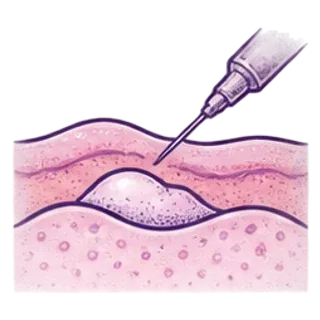
Fill the fold
Lift the crease from underneath.
 Filler

Plump the surface
Hold water in the outer skin.
 Moisturizer
Where the 100 points go
Preventing wrinkles, scored out of 100. Four boring habits earn 80.
Points are Eva AI’s judgment, not study results. Pick any box to see its evidence.
The foundation80 points
Optional extras20 points
Adds little or nothing
These points are Eva AI’s judgment, not study results. We make software for aesthetic practices, including some that offer these treatments.
How we scored this
They lean toward prevention, where the evidence on this page is strongest, and we weighed that against cost, risk and effort for a typical adult, rounded to the nearest 5. Treatments can still matter for lines you already have. Your skin, budget and clinician may say otherwise.
Questions about wrinkles
Short answers, from the story and its sources.
What causes wrinkles?
Skin rests on two proteins: collagen, which holds it, and elastin, which springs it back. Collagen falls about 1% a year through adult life67, and every expression folds the same thin skin, so lines form at right angles to the muscle’s pull10. Sunlight speeds it up: it breaks collagen down15 and knots elastin17. Smoking shows in the face too20, and the fat and bone underneath change with age2627.
What is the difference between dynamic and static wrinkles?
A dynamic line arrives with an expression and leaves with it. A static line stays when the face is at rest1112. Static lines usually start as dynamic ones: the same fold, repeated for years, in skin that no longer springs all the way back.
At what age do wrinkles start?
There’s no fixed age. Collagen falls about 1% a year through adult life67, but it takes years to show, and the first lines come and go with expression11. Sun and smoking bring them forward3120. Darker skin tends to show wrinkles later, often by a decade or more19.
Does sunscreen prevent wrinkles?
It has the strongest evidence of anything sold for wrinkles. In a trial of 903 Australian adults under 55, the group assigned daily sunscreen showed no detectable increase in skin aging over four and a half years, and aged about 24% less than the group that used it when they chose32. The trial used SPF 15 or higher33; dermatologists now advise broad-spectrum SPF 30 or higher, reapplied every two hours outdoors34.
How much of skin aging is caused by the sun?
One L’Oréal-led study of 298 French women scored the sun at about 80% of visible facial aging signs31. That’s one group, not a rule. In 186 pairs of identical twins, the twin with more sun or smoking tended to look older21, and a man who drove a delivery truck for more than 25 years had far more sun damage on the window side of his face28. Up to 80% of UV gets through cloud, and UVA passes through ordinary window glass14: in a study of 29 cars, side windows blocked just 71% of it on average30.
Does retinol work on wrinkles?
Prescription tretinoin has the best evidence of any cream for sun-aged skin: in one trial, collagen formation rose 80% over 10 to 12 months and fell 14% on placebo3536. Over-the-counter retinol is milder, with smaller studies3738. Both take months and can irritate, and retinoids shouldn’t be used during pregnancy.
What is the difference between Botox and filler?
Botox (botulinum toxin) blocks the signal from nerve to muscle, so it softens lines made by movement, not deep lines already there at rest4111. It usually lasts about 3 to 4 months, sometimes longer42. A hyaluronic acid filler is a gel placed under a fold to lift it from below43. It typically lasts 4 to 12 months, some up to two years44, and it treats the shape of a line, not its cause. Both are medical procedures, and a licensed provider should judge what suits your face.
Can wrinkles be reversed?
Partly. Tretinoin and fractional lasers help skin lay down new collagen354546. Botox and filler change how a line looks while they last. Moisturizer softens the look of fine lines but rebuilds nothing39. Nobody gets the years back; daily sunscreen is what keeps more of them from adding up32.
Do collagen supplements, drinking water or face yoga reduce wrinkles?
Not on current evidence. Collagen supplements look good in pooled trials47, but a 2025 analysis that set aside low-quality and company-funded studies found the benefit disappeared48. Extra water may slightly hydrate the surface, with no good evidence it changes wrinkles49. Face yoga rests on one uncontrolled pilot study of 16 women50.
Sources
Checked October 30, 2026. The slide is a drawing, and the timings and ages in it are exaggerated so you can feel them; they are not measurements of anyone’s skin. This page is education, not a diagnosis or a treatment plan. No product here paid to be mentioned.
- DermNet: Structure of the epidermis
- Weinstein GD et al., 1984: epidermal cell kinetics
- Shin JW et al., 2019: dermal aging review
- Baumann L et al., 2021: elastin in skin
- StatPearls: Lower eyelid laxity examination
- Shuster S et al., 1975, British Journal of Dermatology
- Park S, 2022, Biogerontology
- StatPearls: Orbicularis oculi anatomy
- Lee Y, Hwang K, 2002, Surgical and Radiologic Anatomy
- American Family Physician, 2014: botulinum toxin for facial lines
- DermNet: Botulinum toxin
- American Academy of Dermatology: Reducing premature skin aging
- D’Orazio J et al., 2013, International Journal of Molecular Sciences
- American Academy of Dermatology: Sunscreen facts
- Fisher GJ et al., 1996, Nature
- Fisher GJ et al., 1997, New England Journal of Medicine
- Rittié L, Fisher GJ, 2015: natural and sun-induced aging
- DermNet: Solar elastosis
- Vashi NA et al., 2016: aging differences in skin of color
- Okada HC et al., 2013, Plastic and Reconstructive Surgery
- Guyuron B et al., 2009, Plastic and Reconstructive Surgery
- Dyer DG et al., 1993, Journal of Clinical Investigation
- Verzijl N et al., 2000, Journal of Biological Chemistry
- Calleja-Agius J et al., 2007, Menopause International
- Brincat M et al., 1987, Obstetrics & Gynecology
- Rohrich RJ, Pessa JE, 2007, Plastic and Reconstructive Surgery
- Shaw RB et al., 2011, Plastic and Reconstructive Surgery
- Gordon JR, Brieva JC, 2012, New England Journal of Medicine
- WBUR, 2012: coverage of the truck driver case
- Boxer Wachler BS, 2016: UVA through car windows
- Flament F et al., 2013, Clinical, Cosmetic and Investigational Dermatology
- Hughes MCB et al., 2013, Annals of Internal Medicine
- Green A et al., 1999, The Lancet
- American Academy of Dermatology: How to apply sunscreen
- Griffiths CEM et al., 1993, New England Journal of Medicine
- Weiss JS et al., 1988, JAMA
- Kafi R et al., 2007, Archives of Dermatology
- American Academy of Dermatology: Retinoid or retinol?
- National Institute on Aging: Skin care and aging
- Borchers & Pirrung, 2024: the 1,000× hyaluronic acid claim
- StatPearls: Botulinum toxin
- Cochrane review: botulinum toxin for facial lines
- American Academy of Dermatology: Filler FAQs
- American Society for Dermatologic Surgery: Hyaluronic acid
- Manstein D et al., 2004, Lasers in Surgery and Medicine
- Hantash BM et al., 2007, Lasers in Surgery and Medicine
- de Miranda RB et al., 2021, International Journal of Dermatology
- Myung SK, Park Y, 2025, American Journal of Medicine
- Akdeniz M et al., 2018, Skin Research and Technology
- Alam M et al., 2018, JAMA Dermatology
- Anson G et al., 2016, Aesthetic Surgery Journal
- Traikovich SS, 1999: topical vitamin C
- Bissett DL et al., 2005: niacinamide
- Robinson LR et al., 2005: peptides